Brownstone roots
In the late 1800s the hills of what was then Longmeadow's East Village held dozens of small red-sandstone quarries. Workers came from Sweden, France and Italy, and the stone went into buildings well beyond the Pioneer Valley, including Trinity Church in Boston.
Bungalows, estates and postwar neighborhoods
A Massachusetts Historical Commission town survey describes streetcar-era bungalows along North Main Street and larger estates on Prospect Street and Markham Hill. During World War II, a Pratt & Whitney plant brought an industrial area near the old railroad depot, and a lot of the town's housing was built in the decades after the war.
Capes, knee walls and ice dams
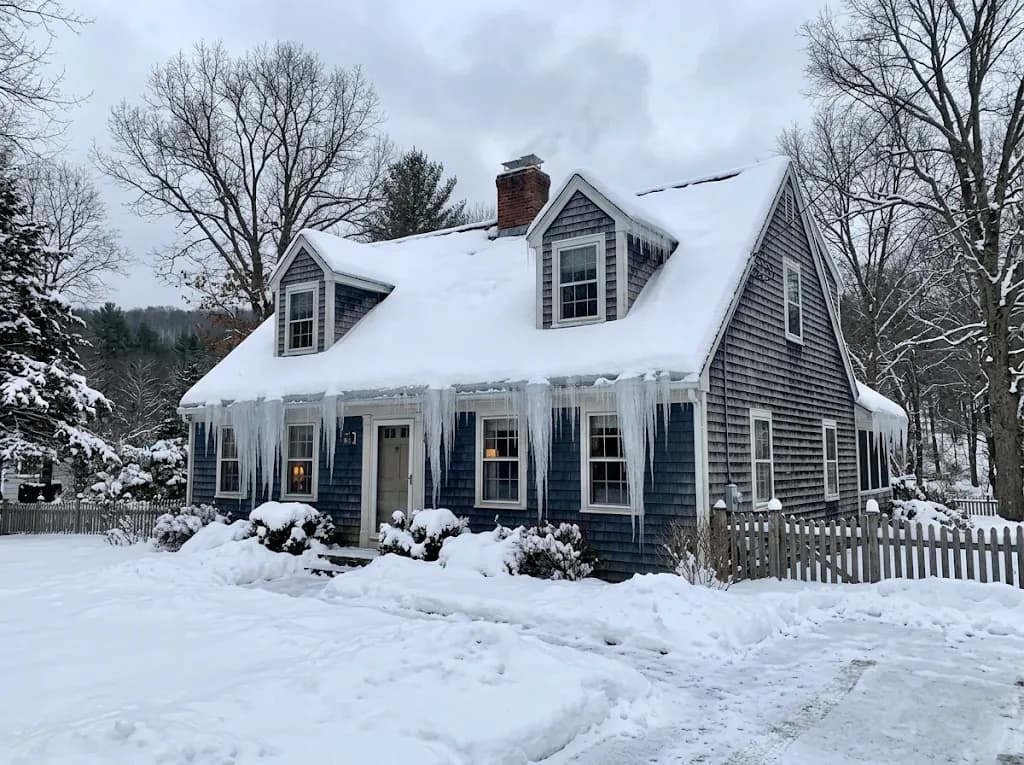
Cape-style homes with finished upper floors are common across the area, and their sloped ceilings and knee walls leave little room for insulation and airflow. Heat reaches the roof deck, melts snow, and the water refreezes at the cold eaves. A replacement is the moment to add a full ice barrier and improve ventilation where the framing allows. Our ice dam guide explains the details.
Permits in East Longmeadow
The town's building department issues reroof permits. Your contractor typically files the application and names the Construction Supervisor overseeing the work.
Want a contractor to look at your roof? One call connects you with a participating local roofer.
Call (888) 292-4916East Longmeadow roof questions
Why do Cape-style homes get so many ice dams?
Finished upper floors with sloped ceilings leave little room for insulation and airflow, so heat reaches the roof and melts snow that refreezes at the eaves. A replacement is a chance to add ice barrier and improve ventilation where the framing allows.
Does this line cover all of East Longmeadow?
Yes, subject to contractor availability.